Sunday, January 13, 2013

Civil Rights Advocate Dies


Eugene Patterson, voice on civil rights, dies at 89

  • Obit Eugene Patterson_Cala.jpg


    Eugene Patterson, a Pulitzer Prize-winning editor and columnist whose impassioned words helped draw national attention to the civil rights movement as it unfolded across the South, has died at 89.

    Patterson, who helped fellow whites to understand the problems of racial discrimination, died Saturday evening in Florida after complications from prostate cancer, according to B.J. Phillips, a family spokeswoman
    .
    Patterson was editor of the Atlanta Constitution from 1960 to 1968, winning a Pulitzer Prize in 1967 for editorial writing. His famous column of Sept, 16, 1963, about the Birmingham, Ala., church bombing that killed four girls -- "A Flower for the Graves" -- was considered so moving that he was asked by Walter Cronkite to read it nationally on the "CBS Evening News."

    "A Negro mother wept in the street Sunday morning in front of a Baptist Church in Birmingham," Patterson began his column. "In her hand she held a shoe, one shoe, from the foot of her dead child. We hold that shoe with her.


    Read more: http://www.foxnews.com/us/2013/01/13/eugene-patterson-voice-on-civil-rights-dies-at-8/#ixzz2HtGMphZl


Source: AP and (AP Photo/The Tampa Bay Times, Cherie Diez) TAMPA OUT; CITRUS COUNTY OUT; PORT CHARLOTTE OUT; BROOKSVILLE HERNANDO TODAY OUT (Tampa Bay Times2012)


Saturday, January 12, 2013

Supporting Multiracial Children


Supporting multiracial children

Actor Lee Gwang-soo, center, poses with children from multiracial families before making “bibimbap,” or rice mixed with meat, vegetables and condiments like red pepper paste, using foodstuff donated by CJ Foodville, at the Korea Support Center for Foreign Workers in Guro, southwestern Seoul, Friday. CJ is trying to globalize bibimbap by launching its restaurant chain, Bibigo, internationally. / Yonhap
Source: The Korea Times

Thursday, January 10, 2013

So...so...Soledad!


So…so…Soledad!

Soledad O’Brien is up to her old one-drop rule rhetoric once again. She was interviewed for an Internet publication called Clutch. If you really want to read it, the link to the full story is:
http://www.clutchmagonline.com/2012/12/catching-up-with-black-in-americas-soledad-obrien/

My problems with the article begin with a personal story of the writer, Zettler Clay—a black male—who tells us how he took his cousins, ages four, six, and eight, to Toy’s “R” Us after promising them they could get what they wanted. They came upon two dolls, a white one and what the writer calls a “melanated” doll, which is apparently darker than white.

Mr. Clay “strongly suggested” the darker doll, but the kid said no dice, she wanted the white one. The writer gave in, but then suffered some deep trauma for having allowed what he calls “the notion of colorism—the lighter the skin, the better the “doll.” So he turned to Soledad O’Brien, the queen of dark is better than light. You can read “Shame on CNN” on this blog at http://projectrace.blogspot.com/2012/12/shame-on-cnn.html

Soledad says, “It’s [sic] nothing wrong with seeing color, It becomes a problem when people limit and define you by it.” Oh, but it’s OK as long as you are defined as black. Ms. O’Brien, is multiracial, and self-identifies differently depending on the situation said recently that her mother told her not to let anyone tell her she’s not Black. For this interview she changed it a bit and said her mother told her not to let anyone tell her she’s not Black or Latino.

The writer goes on for a while about his feelings about “colorism,” and then Ms. O’Brien says the following:

“I think White in America would be fascinating,” she said. “Many cultures come to this country Italian, Irish, they’re not considered white. Jews, there [sic] not considered white. There’s this whole process of assimilation that Black people have not done, and for obvious reasons. So I think White in America would be a really interesting question.”

Huh? I think she is confused about race, ethnicity, culture, nationality and religion. CNN has already unleashed her on multiracials, which makes me really skeptical of what she would say about whites.

Then Mr. Clay asks Ms. O’Brien what she was hoping to accomplish with her last “Black in America” show and this was her response:

“We decided to be very honest and shed a strong light on some of the issues that were important and relevant. With a news documentary you can do that. This isn’t about spinning or PR. It’s about embracing tough situations, sometimes telling hopeful stories, sometimes telling sad stories. But really ultimately trying to do a very honest job in the stories that we are telling.” A VERY HONEST job? Oh please. They very honestly took a young woman who was proud to be biracial and turned her into identifying as black. Some really bad things come to mind about what they did, but VERY HONEST isn’t one of them.

It goes on and on. I really could not care less about how Soledad feels about race; however, but she is a public figure and influences young people by virtue of her being on TV. In other words, she has been given a platform to report honestly and with journalistic integrity. Instead, she is using that platform to invoke her personal racial identification. Very honestly, we don’t need someone splashed all over our televisions talking about how multiracial people should identify only as black—or is that “solely” as black? 
Source: Clutch/Susan Graham

Wednesday, January 9, 2013

Hurray for the NRA?


Hurray For the NRA?

After the Newtown, Connecticut school massacre, the debate about guns/gun control/firearm reduction began and well it should have. Tomorrow, January 10, Vice President Joe Biden will meet with “stakeholders,” according to President Obama’s announcement on December 19 to convene such a meeting. It was reported by Reuters on December 28 that the NRA had not been invited to the meeting, according to NRA President David Keene.

Law enforcement, cabinet members, mayors of various cities, gun safety groups, and a host of other stakeholders were invited. Then the NRA’s Wayne LaPierre said that armed guards are needed in every school. That doesn’t even deserve a comment. But suddenly, the NRA got invited to the meeting—also called “invited to the table”—and yes, they are going to be there.

I never thought I would be on the same side of anything concerning the NRA, but I’m with them on this one. I am with them because I know what it’s like to be left out of important talks in Washington—Project RACE has been left out for the past 12 years of our 23 year existence. We were the favorite advocates for the multiracial community throughout the 1990s, not because we were the only ones talking, but we had friends in high places listening and we insisted that our allies and some of those naysayers were included. We were coming to dinner and bringing other stakeholders with us. As a result, we were responsible for the decision by the Office of Management and Budget and the US Census Bureau to allow multiracial people to at the very least check more than one box on the census forms and with all other government agencies.

Why the multiracial advocacy lost its place at the table is a long, amazing, involved story—and one for another time, I promise—but once you are uninvited at the table, you are apparently disenfranchised completely by the White House. We have made many attempts to get at least one reliable, responsible, knowledgeable person from the multiracial community represented at meetings in Washington, and although we have not been successful, we do persevere on an almost daily basis, and will continue to do so.

So my hat’s off to the NRA, not because I agree with them, but because they did, indeed, get invited to the table.  


Tuesday, January 8, 2013

Racial Disparities in Strokes


New Study Better Explains Racial Disparities in Strokes

Researchers at the University of Alabama at Birmingham (UAB) School of Public Health say a 10-millimeter difference in blood pressure is associated with an 8 percent increase in stroke risk for white people, but a 24 percent increase in stroke risk for black people.

UAB School of Public Health Department of Biostatistics professor George Howard, Dr.P.H, said these new findings, recently published online in the Archives of Internal Medicine, mean primary care physicians should work closely with their black patients and urge them to take blood pressure medicine, as well as follow up with them to ensure those medications are effective in bringing blood pressure under control.

"It's long been hypothesized that hypertension is one of the major drivers in the racial disparities with stroke," Howard said. "Blacks between the ages of 45-65 are about three times more likely to have a stroke than their white counterparts. The reasons for that were not understood, but this difference is bigger than can be explained simply by the fact that more blacks have high blood pressure. There must be something else going on."

The discovery was part of the long-running REGARDS (Reasons for Geographic and Racial Differences in Stroke) study, led by Howard. Stroke risk was assessed in 30,329 black and white people ages 45 and older enrolled in REGARDS between 2003 and 2007 -- 27,748 were included in this most recent analysis and followed up with through 2011.

Howard says that when these racial differences in the impact of blood pressure levels are coupled with previous REGARDS findings that showed a higher prevalence of hypertension and poorer control of hypertension in blacks, it contributes important information to explaining the racial disparity in stroke risk.

Howard noted that at blood pressures above 140, black REGARDS participants had a 400 percent higher chance of having a stroke, compared with white participants. At pressures of 120 or below, white participants had a higher stroke risk.

According to Howard, the public health burden of the racial disparities in stroke is costly. Having a stroke is expensive -- to the tune of $140,000 -- and the extra strokes in blacks cost $3 billion per year.

"These racial disparities, along with geographic disparities, have been in existence and clearly documented for nearly 60 years," Howard said. "We hope the findings from this study will be used to develop new interventions to reduce these disparities."

In the stroke belt states -- Alabama, Arkansas, Georgia, Louisiana, Mississippi, North Carolina, South Carolina and Tennessee -- the risk of dying from stroke is higher than in other parts of the country. In Alabama, the stroke death rate is 105.5 per every 100,000 people, compared with a national average of 78.6 per 100,000.

For blacks in the stroke belt, the death rate is 146.4 per 100,000, compared to the national average for all blacks of 116.4 per 100,000. For whites in the stroke belt, the rate is 96.4 per 100,000, compared to the national average for all whites of 77.1 per 100,000.
Source: Science Daily

Monday, January 7, 2013

Biracial History 2010

‘One-drop rule’ persists

Biracials viewed as members of their lower-status parent group

The centuries-old “one-drop rule” assigning minority status to mixed-race individuals appears to live on in our modern-day perception and categorization of people like Barack Obama, Tiger Woods, and Halle Berry.

So say Harvard University psychologists, who’ve found that we still tend to see biracials not as equal members of both parent groups, but as belonging more to their minority parent group.

The research appears in the Journal of Personality and Social Psychology. “Many commentators have argued that the election of Barack Obama, and the increasing number of mixed-race people more broadly, will lead to a fundamental change in American race relations,” says lead author Arnold K. Ho, a Ph.D. student in psychology at Harvard. “Our work challenges the interpretation of our first biracial president, and the growing number of mixed-race people in general, as signaling a color-blind America.”

In the United States, the “one-drop rule” — also known as hypodescent — dates to a 1662 Virginia law on the treatment of mixed-race individuals. The legal notion of hypodescent has been upheld as recently as 1985, when a Louisiana court ruled that a woman with a black great-great-great-great-grandmother could not identify herself as “white” on her passport.

“One of the remarkable things about our research on hypodescent is what it tells us about the hierarchical nature of race relations in the United States,” says co-author James Sidanius, professor of psychology and of African and African-American studies at Harvard. “Hypodescent against blacks remains a relatively powerful force within American society.”
Ho and Sidanius, along with co-authors Mahzarin R. Banaji at Harvard and Daniel T. Levin at Vanderbilt University, say their work reflects the cultural entrenchment of America’s traditional racial hierarchy, which assigns the highest status to whites, followed by Asians, with Latinos and blacks at the bottom.

Ho and colleagues presented subjects with computer-generated images of black-white and Asian-white individuals, as well as family trees showing different biracial permutations. They also asked people to report directly whether they perceived biracials to be more minority or white.

By using multiple approaches, their work examined both conscious and unconscious perceptions of biracial individuals, presenting the most extensive empirical evidence to date on how they are perceived.

The researchers found, for example, that one-quarter-Asian individuals are consistently considered more white than one-quarter-black individuals, despite the fact that African Americans and European Americans share a substantial degree of genetic heritage.

Using face-morphing technology that presented a series of faces ranging from 5 percent white to 95 percent white, they also found that individuals who were a 50-50 mix of two races, either black-white or Asian-white, were almost never identified by study participants as white.

Furthermore, on average, black-white biracials had to be 68 percent white before they were perceived as white; the comparable figure for Asian-white biracials was 63 percent.

“The United States is already a country of ethnic mixtures, but in the near future it will be even more so, and more so than any other country on earth,” says Banaji, Richard Clarke Cabot Professor of Social Ethics at Harvard. “When we see in our data that our own minds are limited in the perception of those who are the products of two different ethnic groups, we recognize how far we have to go in order to have an objectively accurate and fair assessment of people. That’s the challenge for modern minds.”

The team found few differences in how whites and non-whites perceive biracial individuals, with both assigning them with equal frequency to lower-status groups. The researchers are conducting further studies to examine why Americans continue to associate biracials more with their minority parent group.

“The persistence of hypodescent serves to reinforce racial boundaries, rather than moving us toward a race-neutral society,” Ho says.
The research was supported by the Harvard University Anderson Fund.
Source: HarvardGazette By Steve Bradt
Harvard Staff Writer
Thursday, December 9, 2010.
Kris Snibbe/Harvard Staff Photographer

Saturday, January 5, 2013

Supreme Court to Tackle Multiracial Child Adoption


High court to tackle Native American adoption dispute

By Bill Mears, CNN Supreme Court Producer
Sat January 5, 2013

Adoption case reaches Supreme Court

STORY HIGHLIGHTS
  • NEW: S.C. couple says it is happy that the high court will hear their appeal
  • Cherokee Indian man won custody of his biological daughter
  • S.C. couple's appeal will be heard by high court
  • A federal law meant to protect Indian family breakup is key to the case
Washington (CNN) -- A custody battle involving the "best interests" of a 3-year-old Cherokee girl will be taken up by the U.S. Supreme Court, an issue spanning the rights of adoptive parents and the desire to preserve Native American families within tribes.

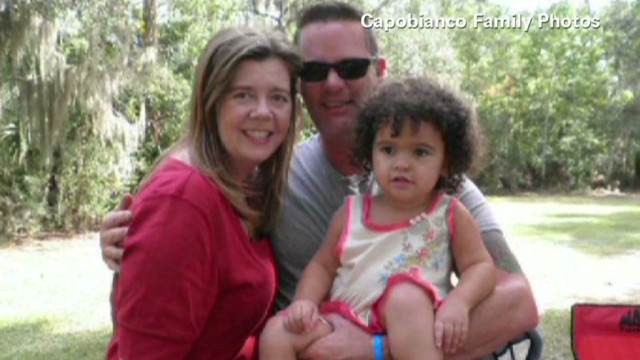
The justices announced they will hear an appeal from Matt and Melanie Capobianco, who legally adopted little Veronica in 2009, shortly after the birth mother agreed to give up the child. Oral arguments in the case will likely be heard in April with a ruling by late June.

The South Carolina Supreme Court in July ruled for the biological father, who had sought custody shortly after the child's birth. He is a registered member of the Cherokee Nation and is raising the child in Oklahoma.

Dusten Brown had earlier signed a legal document agreeing to put the girl up for adoption, but his attorneys say the father did not understand the extent of the waiver, and that the birth mother misrepresented the child's American Indian heritage to social service workers when the adoption was finalized.
At issue is whether Brown, as the onetime non-custodial father, can gain parental custody, after the non-Indian mother initiated an adoption outside the tribe.

A special congressional law governs such interstate adoptions, since the current 556 federally recognized tribes all fall under Interior Department oversight, giving those tribes certain unique benefits and rights.

Lawyers for the Capobiancos say federal law does not define an unwed biological father as a "parent."

The adoptive couple was excited that the high court will hear their case.

"We weren't sure what to expect," Melanie Capobianco told CNN's Randi Kaye. "It was a low chance and we just feel really extremely happy that they decided to hear it."

Her husband, Matt, added, "It restored some hope and a little faith in the judicial system."

The federal law in question is the Indian Child Welfare Act (ICWA) of 1978, a response to decades of often abusive social service practices that resulted in the separation of large numbers of native youngsters from their families, in many cases to non-Indian homes.

The legislation was designed to "promote the stability and security of Indian tribes and Indian families by the establishment of minimum federal standards to prevent the arbitrary removal of Indian children from their families and tribes and to ensure that measures which prevent the breakup of Indian families are followed in child custody proceedings."

Brown's relationship within the "federally recognized government" of the Cherokee Nation means Veronica -- named in court papers as "Baby Girl" -- is a member of the tribe and subject to their jurisdiction.

"It's not anyone's intent ever to rip a child away from a loving home," said Todd Hembree, the Tahlequah, Oklahoma-based tribe's attorney general. "But we want to make sure those loving homes have the opportunity to be Indian homes first."

Still, the Capobiancos argue that the little girl's real home is with them.

"Veronica was always a part of our home from birth and we just felt like she was in a happy place and that those kinds of needs could have been met through us," Melanie Capobianco said. "I just don't think that was what Congress was thinking about when that act was passed."

As with many custody fights, there is wide factual disagreement over the circumstances of both the couple's breakup and subsequent adoption of the child. Opposing sides even disagree on what legal issues the high court should address.

The Capobiancos think the issue should be about whether the ICWA law can improperly block adoption proceedings voluntarily initiated by a non-Indian mother who had sole custody of her child, due to what the adoptive parents say is the Indian father's failure to establish a legal parent-child relationship under state law.

But Brown argues he successfully established paternity under state law, and qualifies as a "parent" under the ICWA, thereby giving him proper control and custody of his daughter.

He said in legal papers that the child was conceived when the couple was engaged, and "excited" he would be a father. But Brown claims the biological mother broke off the now-strained relationship by text message. He agreed to relinquish his parental rights in exchange for not paying child support, but said the mother never indicated she intended unilaterally to give the child up for adoption.

And Brown claims the biological mother tried to "conceal" his Indian heritage during the adoption process with the Capobiancos, who live in Charleston, South Carolina.

Establishing such heritage would normally make it very difficult for the Cherokee Nation and state social services to agree to any non-Indian adoption and removal from the state.

By this time, Brown was deployed to Iraq on a one-year deployment in the U.S. Army, making it hard to press his custody claims. Veronica lived with the Capobiancos for two years before the high court in South Carolina ruled for the father. Brown took his daughter back to Bartlesville, Oklahoma, on New Year's Eve 2011.
The state's top court that ruled in his favor said Brown had "a deeply embedded relationship" with his American Indian heritage, in which Veronica will be raised.

But the Capobiancos point to another part of the state court's conclusion: that despite a ruling against them, they were "ideal parents who have exhibited the ability to provide a loving family environment." That court said its hands were tied, and that federal law trumped state law.

"Courts in seven states have held that ICWA does not bar courts from terminating the parental rights of a non-custodial father under state law when the father abandoned his child to the sole custody of a non-Indian mother," said Lisa Blatt, attorney for the couple.

She says the father's initial agreement to give up his parental rights meant he forfeited any subsequent efforts to establish custody, when the child was already in a happy, stable home environment.
The Capobiancos argue Brown had refused to offer any financial assistance to the biological mother until they were married and "wanted nothing to do" with the pregnancy.

As a single mother with two other young children, the biological mother felt she had no choice but to give her daughter up for adoption, said a legal brief filed by her lawyers. They say she complied with the adoption laws in both states and with the tribe.
The couple also says they long wanted to be parents and had seven unsuccessful attempts at in vitro fertilization.

She is a child developmental psychologist and he is an automotive body technician. They were in the room when Veronica was born, and had an "open" adoption, meaning the biological mother could and did maintain a relationship with Veronica.
The case is Adoptive Couple v. Baby Girl, a Minor Child Under the Age of Fourteen Years (12-399). 
Source: CNN

Another Interracial Family in Washington Politics


Sean Maloney gets right to work in Washington

Congressman casts first vote after taking oath


John Boehner, Sean Patrick Maloney
Rep. Sean Maloney sworn in with his husband and children. House Speaker John Boehner, left, and Rep. Sean Patrick Maloney, D-N.Y., right, on Thursday. With them are Maloney's partner Randy Florke and daughters Essie and Daley Maloney Florke. / Charles Dharapak/AP

WASHINGTON
 — Sean Maloney, a Democrat from Cold Spring, took the oath of office Wednesday as the new congressman representing the Lower Hudson Valley.
Maloney joined most members of his party in unsuccessfully voting for Democratic Rep. Nancy Pelosi of California to serve as House speaker.
Instead, Pelosi will continue to serve as House minority leader. Republican Rep. John Boehner of Ohio was re-elected as speaker.
Maloney brought two of his three children to the floor of the House for his official swearing-in by Boehner, who followed the custom of swearing in all House members en masse immediately after his selection as their leader.
Maloney is one of 21 Democrats in the New York delegation and one of two members of Congress named Maloney representing New York in the House (the other is Democratic Rep. Carolyn Maloney of Manhattan). That means the House will list Sean Maloney’s first name for all votes.
Another new member of the New York delegation, Republican Rep. Chris Collins of Buffalo, is one of two House members with that name, but he will be known as Collins of New York. The other Collins is Republican Rep. Doug Collins of Georgia.
Maloney’s first New York-related vote will be today, when the House is scheduled to consider giving the National Flood Insurance Program an additional $9.7 billion in borrowing authority to handle claims filed in connection with Superstorm Sandy.
He expressed disappointment that the House did not vote earlier this week on a package of $60.4 billion in Sandy disaster aid prior to the end of the 112th Congress.
“I think it’s a disgrace it hasn’t happened before now,” he said.
Maloney plans to deliver his first floor speech today in support of the flood insurance funding.
Because of redistricting, New York has two fewer House seats — 27 instead of 29 — as the new Congress begins. The number of Republicans in the delegation has decreased from eight to six.
Among the former Republicans is former Rep. Nan Hayworth of Bedford, who was defeated by Maloney in November.
Source: AP and Gannett

Friday, January 4, 2013

Multiracial Hockey Star Gets Noticed


A Rising Hockey Star With N.B.A. DNA

Seth Jones probably should have wound up a basketball player. He is tall, with a great vertical leap, and his father is Popeye Jones, who played 11 years in the N.B.A. and is now an assistant coach with the Nets.

But instead, Seth Jones, 18, is projected to be a top pick in the N.H.L. draft and may be on his way to becoming hockey’s first African-American star.

“I’d be shocked myself if I heard a story like that,” Jones said, when asked if people are surprised by the combination of a basketball father and a hockey son. “Me and my two brothers all play hockey, so it was weird, I guess, that none of us played basketball.”

Jones, a 6-foot-4 defenseman with slick skating and puck-possession skills, seems to have a can’t-miss label sewn onto his hockey sweater. He will help lead the United States team at the world junior championships in Russia next week, even though he is the youngest player on the roster. He was on the team for last year’s tournament as a 17-year-old, but an injury sidelined him just before it started.

Now in his first year with the Portland Winter Hawks of the Western Hockey League, Jones has 28 points in 31 games, third among rookies, and a plus-27 mark, fourth among all players. On the ice he is a commanding presence, a hard hitter. But more often he is the rare defenseman who can control a game’s tempo with his stickhandling and passing — a “full-package defenseman,” in the words of Phil Housley, the United States coach.

Probably not what anyone expected from a son of Popeye Jones.
“No one wants to live in their father’s footsteps,” Seth Jones said this week when the United States team held a three-day training camp at the Rangers’ practice rink in Greenburgh, N.Y., before heading to Europe. “I think the time will come when I stop getting those questions and everyone knows the story. That’s just my family and my background and part of my life.”

Jacob Trouba, another defenseman on the national team, said: “He’s always been Popeye’s son. Now he’s turning into Seth Jones; he’s not Popeye’s kid anymore. He’s making his own name.”
Jones may not have followed in his father’s footsteps, but the stops in Popeye Jones’s career played a large role in Seth’s hockey development.

Popeye became a hockey fan while playing in Dallas. He arrived in 1993, the year the Stars moved to Dallas from Minnesota. Seth was born outside Dallas the next year. After Popeye was traded to Toronto in 1996, the Jones family was steeped in the game through constant exposure to Don Cherry and “Hockey Night in Canada.”

“When I was a guy growing up, the only sports offered to me in a small town in Tennessee were basketball, football and baseball,” Popeye said.

Seth’s path to hockey started in Denver when his father was playing for the Nuggets in 1999-2000, and his older brother, Justin, wanted to play roller hockey with his school friends. Seth, who was about 5, got a pair of in-line skates, too. When the weather turned cold, they received ice skates and hockey gear, but only played pickup games with other children.

Then one day at the Pepsi Center in Denver, Popeye bumped into Joe Sakic, the Colorado Avalanche captain and future Hall of Famer.

“I don’t think he knew who I was, but I knew who Joe was, and I stopped him and introduced myself and said, ‘My kids want to play hockey, and I really don’t know anything about it,’ ” said Popeye, who is 6-8. “He looked at how big I was and said: ‘Make sure they know how to skate. I’m sure they’ll be good athletes.’ ”

Seth took skating lessons with a figure-skating instructor for a year, but what sealed hockey for him was sitting rinkside with Justin and his younger brother, Caleb, when the Avalanche won Game 7 of the 2001 Stanley Cup finals.

“Seeing the Cup in person was just unbelievable,” Seth said.
He went on to star on youth teams when the family returned to Dallas and at the elite United States National Team Development Program in Ann Arbor, Mich., winning gold medals at the 2011 and 2012 World U18 Championship. (Caleb, 16, has been invited to the program’s 2013 tryouts.)

The N.H.L., mired in a lockout and struggling to renew fan interest, would probably welcome the marketing potential of a young African-American star, especially if Jones were to play, say, in Brooklyn when the Islanders move there in 2015.

Seth, whose mother, Amy, is white, said he would prefer that race not be part of the conversation when it comes to his hockey career.
“I don’t want to be looked at as an African-American, you know?” he said. “I want to be looked at as someone who has good character, and people know me for the person I am, not my color.”

Still, he said he understood why people asked about race. “Anytime I or anyone can help to get kids into the sport of hockey — or any sport, as a matter of fact — it’s huge,” he said.

But he added that being that kind of role model “can put a lot of weight on your shoulders.”

In 1958, Willie O’Ree of the Boston Bruins became the first black player to skate in an N.H.L. game, and only a few others — all Canadian — appeared in the league over the next 20 years. But as Canadian demographics changed, more and more black players made N.H.L. rosters, and by the mid-1990s, it was no longer especially noteworthy to see black athletes in N.H.L. uniforms. 

Grant Fuhr won four Stanley Cups in five years as an Edmonton Oilers goaltender and was Team Canada’s goalie in the 1980s. Donald Brashear, born in Indiana but raised in Quebec, was one of the most feared fighters of the 1990s. After 15 seasons and 516 goals with the Calgary Flames, Jarome Iginla is one of the most popular players in Canada.

But fewer than a dozen African-American players have skated in the N.H.L. in its 95 years of existence. Val James was the first, in 1981, and about half of the total are listed on current rosters. Only one of the players can be considered something of a star: the Winnipeg Jets’ Dustin Byfuglien, who as a Chicago Blackhawk in 2010 became the third black player, and the first from the United States, to have his name inscribed on the Stanley Cup. (Fuhr, Brashear, Iginla and Byfuglien are all biracial, like Jones.)
Jones said he had never encountered a problem because of his race, on or off the ice. Racially charged incidents on North American rinks have become increasingly rare. Growing up in 1980s Boston, Mike Grier, who retired last season after a 14-season career with four N.H.L. teams, recalled hearing occasional racial slurs from opponents and parents.

Still, there is the occasional incident. Last year, Philadelphia’s Wayne Simmonds, a black Canadian, was taunted by a fan who threw a banana on the ice at a preseason game in London, Ontario. The fan was turned in by other fans and prosecuted.

In the playoffs, Washington’s Joel Ward, also a black Canadian, eliminated the defending champion Bruins with a Game 7 overtime goal, unleashing a torrent of racist comments on social media.
As Simmonds observed after his incident, “When you’re a black man playing in a predominantly white man’s sport, you’ve got to come to expect things like that.”

Still, Jones said he had not experienced anything of that nature, and his basketball connections might prove to be the more unusual part of his background.

Basketball and hockey do not often overlap. Alex Ovechkin is one of the few N.H.L. players with a basketball background; his mother starred for the Soviet national team. Los Angeles Lakers point guard Steve Nash played hockey while growing up in Canada.
Jones acknowledged that the two sports did not have much in common, but said he learned from watching basketball players.

“The persons I watched closely were Dirk Nowitzki and Jason Kidd,” he said, recalling when his father was an assistant with the Dallas Mavericks. “You’d see Dirk back there behind the scenes taking jump shots before and after games, before and after practices. It just taught me to keep working hard when no ones’s watching, and the person you are behind the scenes is your true self.”

Seth never played organized basketball, but some of Popeye’s basketball DNA seems to have rubbed off.

“We played basketball in Ann Arbor a lot the last couple years, and he’s got a lot of talent,” said Brady Skjei, a United States teammate who spent two years with Jones at the National Team Development Program. “Great hands, a soft stroke, a terrific shot.”

Jones said: “I actually am pretty good at basketball, I have to admit. I have a nice two-way game, I think.”

Popeye and Seth disagreed over which of them would win a game of one-on-one basketball. But Popeye, who was chosen in the second round of the N.B.A. draft, figured Seth would top him in draft position.

“He’s passed his dad, and that’s pretty cool,” Popeye said.   
Source: The New York Times     

Wednesday, January 2, 2013

Teachers Union Sues based on Race Discrimination

Stories like this always make me wonder about the multiracial teachers... -Susan

Citing Race Discrimination, Chicago Teachers Union Sues Over Layoffs


The Chicago Public Schools' recent rounds of layoffs have disproportionately affected African-American teachers, the Chicago Teachers Union alleges in a class action filed this week.

Even though black teachers make up only less than 30 percent of the teaching force, they were hardest hit by the layoffs, the lawsuit states. For example, of the 347 tenured teachers laid off in 2012, 51 percent were African-American.

In the lawsuit filed Dec. 27, the union says that the district's "turnaround" efforts, which involve the replacement of up to every teacher in a school so designated—and sometimes the conversion of the school into a charter—are to blame for the disproportional layoffs. Those schools have been located on the city's west and south sides, where many African-American teachers work. And the district's process for selecting the schools for turnaround isn't transparent or clear, the union contends.

The lawsuit seeks a moratorium on turnarounds and the implementation of "less discriminatory alternatives."

The CTU has long been opposed to turnarounds, which threaten its membership numbers as well as longstanding perks like seniority. But the policy has also been controversial among teachers, students, and communities.

The lawsuit could have national implications, too, given that Chicago's turnaround program was the basis of the federal School Improvement Grants, under which "turnaround" is one of the four allowable options.
We'll wait to see how the district responds.
Source: Education Week/Stephen Sawchuk